You have two pieces of reearch to do.
1. Research an element of design; create slides, add video links to our power point on Google Drive, be ready to talk about that element on the day when it is your turn.
2. Research the principle of design that is the focus of your grade (grade 7 unity and harmony, grade 8 movement). Discuss how this principle is evident in a work of art of your choice. Due date to be decided.
Wednesday, 18 February 2015


Tuesday, 17 February 2015
Monday, 16 February 2015
Revising Written Work
You brainstormed. You wrote a plan. You wrote a first draft based on your plan. Now it's time to revise.
In revisng the writing pieces about our Ottawa trip, we are working on the curriculum expectation "make revisions to improve the content, clarity, and interest of written work". Below are some tips to consider for this piece about Ottawa, but that can be useful for other pieces as well.
Content (What information, details you have in your work)
- At this point you should be offering more than a basic recount.
- If your work consists only of "we saw this" and "we did that" type of sentences, your content is probably too simplistic for grade level.
- A good mix of "This reminded me of", "I learned this knew thing", "This is significant because", "This made me realize/think of" "I wonder" type of sentences offer greater complexity. These kinds of sentences involve
- making connections (to self, text, world)
- analysing (seeing how things fit together)
- conjecturing (guessing, predicting)
- evaluating (making judgements)
Clarity (Whether your ideas are clearly expressed)
- read your work aloud, this is the first quick way to spot mistakes that interfere with meaning
- have someone else read your work, they might spot something you missed
Interest (How much someone will enjoy reading what you wrote)
- use a "hook" to grab the attention of your audience, some example of what might be used as hooks
- statistics
- definition
- quote
- question
- startling statement
- humour
- analogy
- anecdote (a quick, funny story)
- use a topic sentence to set focus
- use word pictures (try using figurative devices we are learning about in class)
- use a variety of sentence types and structures (long, short, compound)
- use your own voice (appropriate to the purpose and audience)

Friday, 13 February 2015
Exploring Similarity
1. Draw a pentagon (or any 2D shape) labeled ABCDE.
2. Place a point P anywhere on the sheet.
3. Draw Lines from P through each vertex.
4. Place Point A' twice as far from point P as A is from P. Repeat for all the points.
5. What do you notice?


2. Place a point P anywhere on the sheet.
3. Draw Lines from P through each vertex.
4. Place Point A' twice as far from point P as A is from P. Repeat for all the points.
5. What do you notice?
 |
Two
shapes are similar if all their corresponding angles are congruent and
their corresponding sides are proportional.
|
 |
| "Proportional" means that there is a multiplicative relationship between the sides - that is to say that multiplying one side by x always leads you to the length of the corresponding side. In this case x = 2. Notice that AB = 2.5cm and A'B' = 5cm. |
 |
| It doesn't matter where you placed the point P. Maryam placed it somewhere inside the triangle. |
Tuesday, 3 February 2015
Science Centre
It was a journey into the unknown. A group
of youngsters and their leaders, with bright, eager faces and minds
determined to learn new things walked down the pathway towards discovery. Ok, it wasn’t a quest; it was just a trip to the
Ontario Science Centre. But what a trip
it was! We had a great time adding new information (mostly about how the brain works, and understanding structures) to our hard
drives.
Look at that; a metaphor for the mind! The mind might be seen as a computer with storage areas that can fit large amounts of information that can be retrieved when we want it. If the mind is like a computer, what would a mental illness be? A Computer virus maybe? Coincidentally, we are learning about metaphors in class so it was interesting that one of the first exhibits we saw listed several metaphors that illustrate how the mind works. The metaphor of the mind as a computer wasn’t the only one; the exhibit also showed us how we might compare the mind to a hydraulic system, a container, a room, a mystery box, a loom, a sheet of paper. It turned out that this exhibit (Trying Out Metaphors of the Mind) was just a teaser for the huge exhibit on the sixth level called Brain: The Inside Story.
Unfortunately, since the bell went as we co-wrote this piece, this is where the prose ends. We'll finish documenting our learning by writing captions for the photos below.


 |
| These wires represent the pathways in our brains. Messages are constantly being sent along these pathways. |


 |
In this experiment, we learned that triangles make a bridge stronger and that it helps the bridge support more weight onto itself. This is because of the way the triangle bridge is shaped, upside-down or rightside up there will always be a way for the triangles to support the bridge. But even if one side of the triangles is taken out then the bridge will snap from which ever side is taken out. In conclusion, triangles are a very strong shape that can support a lot of weight. (M.S)
|
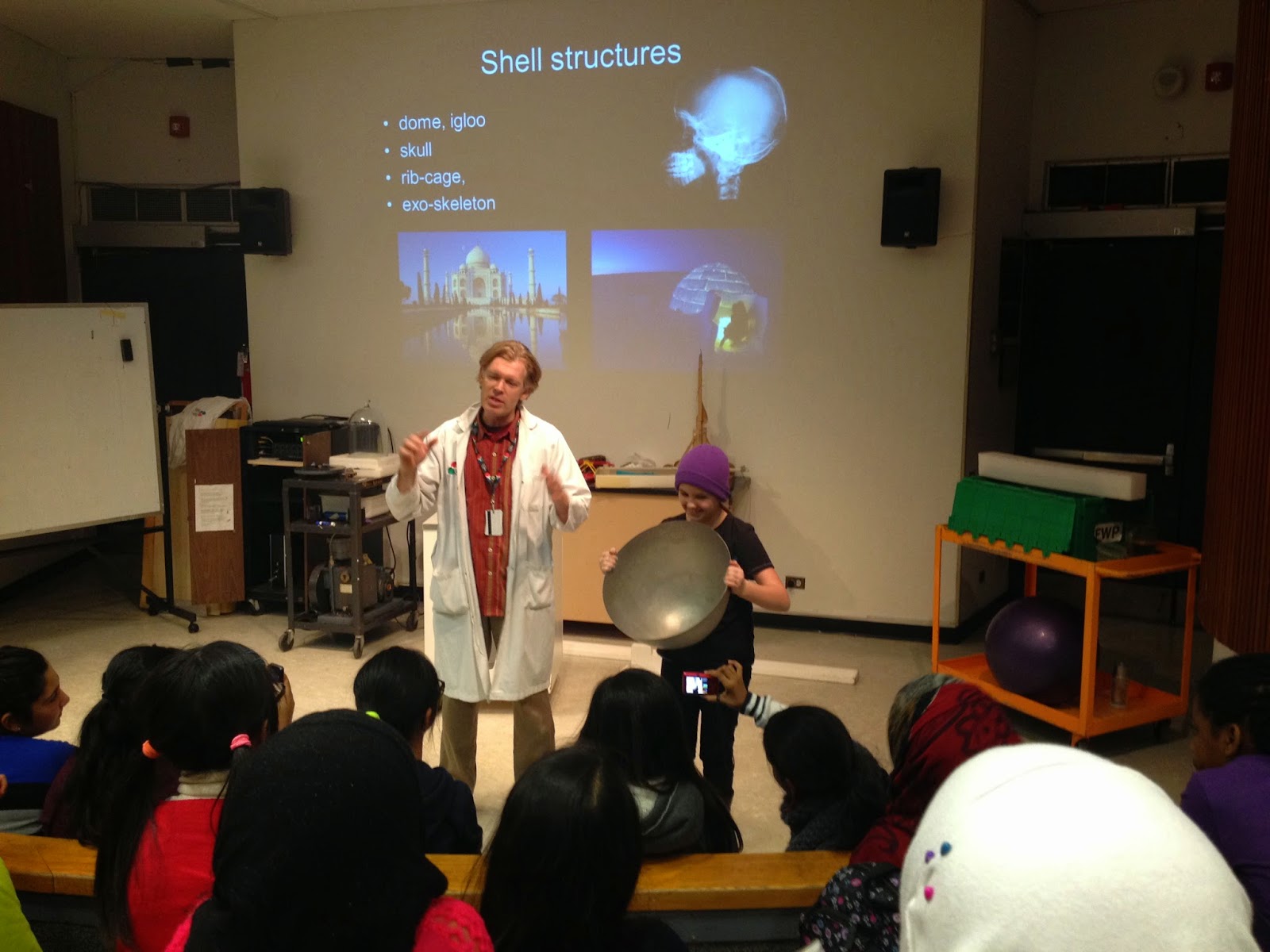 |
In this experiment we learned that a dome structure can be a very elastic structure that can withstand a lot of compression and tension. In the photo it shows that the dome can be compressed inwards very far and it can bounce right back into the same shape that it already was in the first place.We learned that an elastic material is one that goes back to its original shape after some kind of force had deformed it. Bythat understanding, the metallic dome is elastic! Even the pieceof board they stood on earlier is elastic.
 |

 |
This picture shows a girl about to lie down on a bed of nails whilst being helped by a man. well, if you don’t know anything about this science trick, you most likely have a bunch of questions running through your hard drive. Opening up files and trying to find answers. This term bed of nails, may make you think of it being painful, but when in reality, it doesn’t hurt at all.
Let me explain.
Let’s say it was only one nail, the nail would add pressure and pierce through your skin making you pound in pain. But a bed of nails, is a bunch of nails close together, that you’re laying on, your body is covering. All the needles support your body which results to no pain, whilst one needle results to pain. To add on - the needles are at the same level, not one taller than the other. If a needle was really taller than the other, it would result in pain. (S.D)
|
 |
| Learn more about why the nails don't poke into her flesh. In this picture, the little girl is laying on the bed of nails with a foam atop of her, and a board laying on top of the soft foam. As you can see in the picture, the man is holding a hammer, and yes, he hit the board. But it didn’t hurt. Nor will it, if you hit so hard with a baseball bat. And this is because the force of the baseball bat and hammer goes on the board, the soft foam underneath protecting her from being pushed down, softly just going against her. and even if she felt the force, it wouldn’t have hurt because the weight of her body is spread out over many nails at the same level of length supporting her weight. The force of the weight of her whole body on only one nail would that one nail to puncture her body. (S.D) |


Math Review
Here is a set of great responses from your classmates.
Geometry - construction
Geometry - intersecting lines
Geometry - A square is a special kind of trapezoid, explain -First she lists the minimum required properties for a trapezoid (by the way the first one on her list is incorrect), then she shows that a square meets these requirements and more, therefore a square is a kind of trapezoid.
Measurement - solving problems involving conversion of units
Number Sense - a mish-mash of skills
Patterning - notice how she uses lines (hint elements of design from media literacy) to organize her information.
Geometry - construction
Geometry - intersecting lines
Geometry - A square is a special kind of trapezoid, explain -First she lists the minimum required properties for a trapezoid (by the way the first one on her list is incorrect), then she shows that a square meets these requirements and more, therefore a square is a kind of trapezoid.
Measurement - solving problems involving conversion of units
Number Sense - a mish-mash of skills
Patterning - notice how she uses lines (hint elements of design from media literacy) to organize her information.
Thursday, 29 January 2015
Canadian Landforms
You will need the Learn 360 password.
The Cordillera and Artic Lands
Canadian Shield, Lowland, Highlands and Plains
The Cordillera and Artic Lands
Canadian Shield, Lowland, Highlands and Plains


Geography update.
Here is what we were able to cross off the list in geography today:


Please read this page, it will reinforce what you already know and give some new information. This tool lets you find the absolute location anywhere on earth, check it out! Use it to find find the absolute location of toronto and 4 other places. Write the co-ordinates in the comment section below.
Hon. Judy Sgro's statement to parliament
I found this on the Hansard for January 27, 2015. The Hansard is a complete recording of every thing that is said at parliamentary debates. If you want to watch the video, click "Statements by Members" on the right menu then click "Black History Month". Click Expand to see the video link.

Monday, 26 January 2015


Subscribe to:
Posts (Atom)